













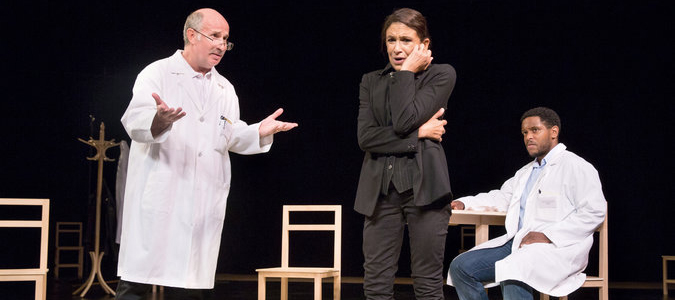

Legendary theater director Peter Brook looks at the neurological condition known as synesthesia
In the new 80-minute piece The Valley of Astonishment, estimable theater makers Peter Brook and Marie-Hélène Estienne explore the inner workings of the brain. The particular focus of the show, which comes to Theatre for a New Audience’s Polonsky Shakespeare Center after a European tour, is the phenomenon called synesthesia, in which one’s senses essentially double up: sounds become colors, numbers become figures. Utilizing their own research and that of eminent neurologists including Dr. Oliver Sacks, the directors present their creation in a theatrically vivid manner, one that isn’t as didactic as you might expect. Those with a background in cognitive science might find the show a bit too recognizable, but for those who don’t, it’s surprising how refreshingly digestible it is. At 89, Brook, whose best known New York credits are the Tony-winning Marat/Sade and the 1971 Midsummer Night’s Dream set entirely in a white box, hasn’t lost the creativity that has set him apart from the rest of the pack for the duration of his long, varied career. There’s barely any set (and no credited designer): just a few tables and chairs surrounded by the vast empty space of Theatre for a New Audience’s three-quarter-thrust stage. This allows our imagination to run as wild as the ones that belong to the characters, played by Kathryn Hunter, Marcello Magni, and Jared McNeill.