













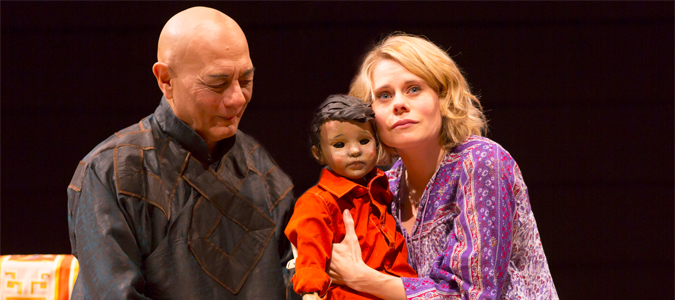

Would you let your three-year-old move away to a monastery in India? Sarah Ruhl imagines you might.
“China invaded Tibet in 1949, under the leadership of Mao,” Sarah Ruhl writes in the program note for her newest play, The Oldest Boy, now making its world premiere at Lincoln Center Theater’s Mitzi E. Newhouse Theater. “More than a million Tibetans were killed. 6,256 monasteries were destroyed and looted, fourteen remain intact.” The shocking facts of Chinese brutality in Tibet are undeniable. Curiously, however, Ruhl never mentions what Tibet was like before Chinese occupation, when the vast majority of Tibetans lived as serfs supporting a handful of noble families and a massive Buddhist clergy. The Western propensity to overlook (or even romanticize) Tibet’s feudal theocracy is very much at the heart of Ruhl’s earnest and slightly naive play. Why do we castigate certain oppressive systems while valorizing others? More important: Whose version of the truth is deserving of our faith and trust? The play takes place in an American city with a large Tibetan community (Ruhl never specifies which). Tenzin is a seemingly average American boy, raised by an American mother (Celia Keenan-Bolger) and a Tibetan father (James Yaegashi) living in exile. (Ruhl also never gives these characters specific names.) Tenzin’s mother and father met when she stumbled into his restaurant one day and never wanted to leave, so enchanted was she with the food and the man who cooked it. Against his family’s wishes, they marry and have a son.