













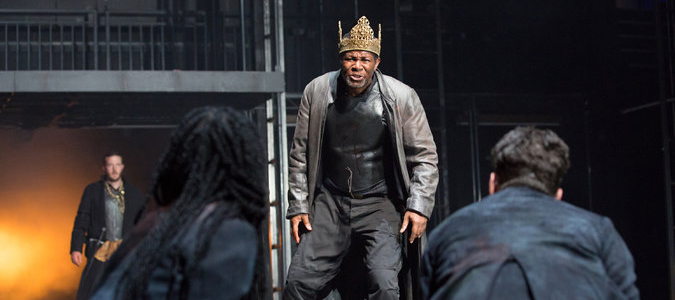

Theatre for a New Audience presents a powerful new mounting of Christopher Marlowe’s epic play, for the first time in a major New York production in 58 years
In a central square of Tashkent, Uzbekistan, where once stood a bust of Karl Marx, a giant statue of the 14th-century conqueror Amir Timur (or Tamerlane), astride a horse, threatens to cut down any challengers. By all estimates, millions of people died as a result of Tamerlane’s brutal campaigns. Since the fall of the Soviet Union, however, Uzbek strongman Islam Karimov has sought to elevate Tamerlane to the position of national hero, drawing not-too-subtle parallels between the infamous butcher and himself. You might wonder why any sane leader would want to invoke the memory of so murderous a historical figure, but after viewing Theatre for a New Audience’s excellent production of Christopher Marlowe’s Tamburlaine, Parts I and II, you’ll have a good idea why. Six hundred years after his death (and over 400 years after Marlowe wrote his breakthrough play), Tamerlane’s legend still has the ability to inspire fear and admiration, disgust and pride. Written in 1587 (and only vaguely historically accurate), Marlowe’s play eloquently captures the ambivalence surrounding the figure of Tamerlane. Part I charts his meteoric rise, starting with his first great victory over Persia. After defeating the foolish King Mycetes (a very funny Paul Lazar) and placing Mycetes’ treacherous brother Cosroe (Saxon Palmer) on the Persian throne, Scythian warrior Tamburlaine (John Douglas Thompson) double-crosses Cosroe and takes the crown for himself. He makes captured Egyptian princess Zenocrate (Merritt Janson) his queen, then moves against the immensely powerful Turkish Emperor Bajazeth (Chukwudi Iwuji) and his 15 tributary kings. These men of noble birth scoff at the notion that they could fall to a nobody from the barren steppes, but Tamburlaine has the last laugh when he leads them away in chains. “The god of war resigns his room to me, / Meaning to make me general of the world,” he declares, believing himself to be more powerful than any god.