












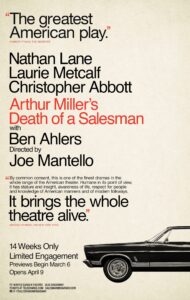





Death of a Salesman
Opening Night: April 9, 2026
Theater: Winter Garden Theatre
Website: salesmanbroadway.com
One man and his family are caught up in the pressures and delusions of living the American Dream. Miller’s play is the story of a traveling salesman whose illusions of picture-perfect business and family life cave in on him. Arthur Miller’s Death of a Salesman returns to Broadway, directed by Joe Mantello. Mantello’s production uncovers new layers in Miller’s masterpiece, revealing unexpected dimensions in a play that continues to resonate with ever more power.
BUY TICKETSREAD THE REVIEWS:


April 9, 2026
Mantello has leaned into the play’s sense of abstraction — Willy often loses himself in his own mind — which has the effect of emphasizing both its timelessness and its timeliness. (Miller’s working title was “Inside of His Head.”) And there’s no doubt that Mantello has made a beautiful, atmospheric production, full of exquisitely calibrated performances.
READ THE REVIEW

April 9, 2026
And yet, I was ultimately unmoved. Why? In sitting uncertainly between total adornment and its weighted ideas of temporal displacement, the production had never quite gotten me there. This Salesman tries to be a few too many things, and. the intended emotional clarity proves just out of its reach.
READ THE REVIEW
April 9, 2026
From the breathtaking opening scene when a car drives onstage, its bright headlights shining into the audience, to the moment it backs out of Chloe Lamford’s astonishing set, this Salesman dazzles. The cast, led by Nathan Lane and Laurie Metcalf, is exceptional, and Joe Mantello’s direction is nothing short of perfection.
READ THE REVIEW
April 9, 2026
A worthwhile revival will always give you the feeling — even more significant than re-seeing an astonishing play — of truly hearing it, and that’s what happens here. Again and again, as Lane moved with desperate, waning vitality from home to office to an almost unbearably painful dinner out with his sons and back to home again, I caught myself flinching at Miller’s words, coming out of these actors with terrible freshness: “Once in my life I would like to own something outright before it’s broken!”
READ THE REVIEW
April 9, 2026
Down to the smallest roles, this production is astutely cast, and its arresting design elements add a suitably shabby grandeur to the play’s unsparing view of America’s broken promises. Mantello does some of his finest work in a heartfelt revival that will be remembered for the estimable Lane’s career-crowning performance. It’s magnificent theater.
READ THE REVIEW
April 9, 2026
But first and last, Salesman is Willy’s story, and generation after Broadway generation has thrown its best into the role, from Lee J. Cobb, Fredric March (in the 1951 film), George C. Scott, Brian Dennehy and Dustin Hoffman to Philip Seymour Hoffman and Wendell Pierce. Lane takes his place among the best, his Willy Loman a powder keg of frustration and disappointment and deep, deep sadness. Lane uses his loud, outside voice to excellent effect, his shouts of exasperation and anger giving way to instant regret and recrimination. Watch, future Willys, and pay attention.
READ THE REVIEWApril 9, 2026
The newest Broadway production of Arthur Miller’s storied play (directed by Joe Mantello) has lost none of its power in the tale of a man fighting the demons of his past while also struggling with the dwindling conditions of his present and the limited prospects for the future. And the material is only heightened by a powerhouse cast at the top of their game.
READ THE REVIEW

April 9, 2026
As with his direction of the actors, however, Mantello likes to pour it on gooey. Each act is introduced with Caroline Shaw’s overly somber music, reaching for but failing to achieve Philip Glass profundity. The fog machine never stops. The overkill begins even before you enter the Winter Garden. Black-and-white photos by Thea Traff (doing her Brigitte Lacombe best) feature the lead actors in stiff poses, trying hard to look terribly serious and appearing really ridiculous.
READ THE REVIEW
April 9, 2026
What’s most striking is the musicality of his voice. This isn’t a musical, and yet it often feels like one when he speaks. Lane shapes Miller’s language as if he’s singing it, or delivering a Shakespearean soliloquy—each phrase carefully pitched, rising and falling with rhythm and intention. He pivots in an instant from buoyant, almost giddy enthusiasm to naked self-pity, then back again, without strain. The shifts are seamless and mesmerizing.
READ THE REVIEW
April 9, 2026
[Lane] is undoubtedly gifted and capable in the part: tender, forceful, and connected to the text. But his natural gentility is tough to dress down. It worked in his favor for his Tony-winning turn as the monstrous Roy Cohn in “Angels in America,” but buying him as an end-of-his-rope everyman taxes the imagination.
READ THE REVIEWApril 9, 2026
The squalid room makes a quick first impression: This place, whatever it is, has certainly seen better days. Then, at the end of the superb and unforgettable revival that hauntingly unfolds there among its shadows, there arrives an altogether livelier takeaway: That was the best “Death of a Salesman” I have ever seen.
READ THE REVIEWApril 9, 2026
Lane’s trademark brassiness lends the character’s long-winded rants an improbably winsome sheen, his embarrassments a piercing ache. There’s a hypnotic rhythm to the madness of his Willy; when it’s time to go, he nearly takes the show with him. It’s a bravura turn, but the show’s heart remains Linda, whom Metcalf imbues with crisp practicality. Dutiful, entirely un-naive and blisteringly angry, she is devastatingly economical even in her most withering and emotionally prostrate moments, Metcalf conveying the exhaustion of a woman used to holding everything together. Together, the two sell what remains, for all its nuances and boosted flavors here, a stark and gutting tragedy. I didn’t always want to, but I found myself buying it.
READ THE REVIEWApril 9, 2026
But the standout performance comes from Laurie Metcalf as Linda Loman. She is the doting wife a man like Willy needs, despite the way he snaps at her (and calls her “kid,” just as his boss calls him). In scenes with Lane, Metcalf’s Linda demonstrates a deep devotion that may or may not be keeping Willy’s delusions afloat. But behind his back, she radiates intelligence and a righteous anger that motivates her aimless sons, however briefly. She is fierce and frustrated, hampered by her inability to help her fragile husband and desperate to keep him safe. Metcalf’s delivery of the line calling Willy “only a little boat looking for a harbor” hits hard, especially given the bleak backdrop.
READ THE REVIEWApril 9, 2026
After his revelatory dramatic performances in The Iceman Cometh and Angels in America, it seemed only a matter of time before Nathan Lane would take on Willy Loman, one of the most iconic roles in American theater. It’s been a long wait, but it has definitely paid off. Add to that Laurie Metcalf as his co-star, several superb supporting performances, and a powerful staging by Joe Mantello, and you have a revival of Arthur Miller’s Death of a Salesman that represents a highlight of the theater season.
READ THE REVIEWApril 9, 2026
[Metcalf’s] loyal, loving, perplexed, often harshly silenced Linda is deeply effective. During her most extended first-act scene, when confronting sons Biff and Happy, she proclaims perhaps the tragedy’s most famous line—“Attention must be paid”—and thereby grabs hold of the production. Nor does she lose velocity in the second act, which includes a less well-known but devastatingly accurate line about her beloved Willy: “he’s only a little boat looking for a harbor.” No flaws undo any of the entire cast, either, with stand-out Abbott intensifying the stifling air with his final heart-wrenching outcries.
READ THE REVIEWApril 9, 2026
There is the new technology Willy doesn’t understand, the disloyalty of his mercenary company that makes him feel betrayed, the humbling that leads him to lash out, making everything so much worse. If there’s an American workplace nightmare, it’s in this scene. Written in 1949! And as played by Lane and John Drea in Joe Mantello’s exquisitely directed Broadway revival, it will sock you in the gut. Sure did me, and I’ve seen this play countless times. Then again, when you get close to Willy’s age, you also start to see this play very differently.
READ THE REVIEW