
















Bug
Opening Night: January 8, 2026
Theater: Samuel J. Friedman Theatre
Website: www.manhattantheatreclub.com
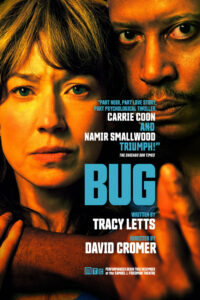
From Tony Award and Pulitzer Prize-winning playwright Tracy Letts (August: Osage County) and Tony Award-winning director David Cromer (Prayer for the French Republic, The Band’s Visit) comes the Broadway premiere of Steppenwolf’s acclaimed staging of a cult classic about an unexpected and intense romance between a lonely waitress (Carrie Coon) and a mysterious drifter (Namir Smallwood). What begins as a simple connection between two broken people in a seedy Oklahoma motel room twists into something far more dangerous. When reality slips out of grasp, paranoia, delusion, and conspiracy take over in this sexy psychological thriller.
BUY TICKETSREAD THE REVIEWS:


January 8, 2026
But what really holds this production together is Coon, an excitingly live-wire performer who sells the play’s hard-boiled poetry with conviction. “I just get sick of it, my lousy life, laundromats and grocery stores, dumb marriages and lost kids,” she says, making you feel her pain. She’s fed up and ready for something, anything new.
READ THE REVIEW
January 8, 2026
Once that descent begins, though, it’s a perverse thrill to the end. Aided by a masterful set change (the decaying scenery is by Takeshi Kata, spookily lit by Heather Gilbert), Cromer expertly turns the dial up to 11 as Agnes becomes fully consumed by Peter’s conspiratorial mind. The late arrival of the mysterious Dr. Sweet, played with almost otherworldly strangeness by an excellent Randall Arney, elevates the proceedings to unnervingly heightened, wholly gripping heights. Even as his characters destroy their world and themselves, Letts never loses sight of the strange comfort in a good conspiracy theory.
READ THE REVIEW
January 8, 2026
Playing a woman with a long-missing child living in constant fear of her ex’s fist, Coon conveys with exacting precision how a lifetime spent asking “why me” can push someone to seek extravagant answers from whatever source seems most plausible, even if those answers are delusions. In her profoundly shattering turn, Coon makes Agnes’s descent at the hands of Peter feel inevitable…Bug is the scariest play ever written.
READ THE REVIEW

January 8, 2026
Letts’s play is a sordid, spiky creature, a two-hour descent into a pit of paranoia within the dingy walls of an Oklahoma motel room. It’s also an acting showcase, especially for its female lead, and Coon tears into the tragic arc of troubled club waitress Agnes White with her characteristic naked courage. But to really do its work, Bug needs to get under our skin, and here it never quite does. We’ve got to feel not only the ick but the itch — the gnawing sensation that, for all their delusions, the protagonists might not actually be nuts. Even if they are, their nightmarish conviction should stick with us. We should walk away struggling to shake the feeling something’s crawling up our backs.
READ THE REVIEW
January 8, 2026
“Bug” is as intimate as it is intense. The set, designed by Takeshi Kata, drops the audience right into this specific place and time. The lightning, helmed by Heather Gilbert, and the sound, spearheaded by Josh Schmidt, also keep the play tightly grounded, though the production may have worked even better in a smaller theater. Additionally, midway through Act II, there is a shocking set change that reveals just how deep into their psychosis Agnes and Peter have sunk. Moreover, amid Agnes and Peter’s continued descent toward insanity, the story remains convincing because of the characters’ obvious affection and mutual obsession. It’s pretty apparent they are causing each other immense harm. However, their actions stem from a place of love, companionship, humor and understanding, which makes the tale especially heartbreaking.
READ THE REVIEW
January 8, 2026
The slipperiness of ostensible skepticism into utter credulity is what makes Bug continue to resonate so powerfully today. This is not just a particularly lurid folie à deux involving a peculiar variety of Ekbom Syndrome. It speaks to a larger crisis that has only expanded since Letts wrote the play: a twisted culture of conspiracy, exemplified by phenomena like QAnon and Pizzagate, that attracts broken people into collective psychosis. That’s the genuine horror built into this play, and perhaps also its most soothing aspect. In Bug, at least, the contagion is contained.
READ THE REVIEWJanuary 8, 2026
The Samuel J. Friedman Theater was rippling with gasps as the show played out, concern palpable in the air. Have they lost their minds? Is this really happening? There was some cowering in seats, some shielded eyes and a general atmosphere of dread. But even if you do avert your eyes from some of the more gruesome developments, it’s near impossible not to peek through your fingers: Bug is all absorbing.
READ THE REVIEW
January 8, 2026
While fascinating in its ambition, pretty early the momentum of the play stalls, and Bug becomes an arduous descent into loud shouting and, ultimately, no answers. Coon and Smallwood’s performances navigating this nightmare slalom are electric. The play, prophetically prescient as it may be, is not.
READ THE REVIEWJanuary 8, 2026
It goes without saying that “Bug” belongs to Coon, whose transfixing tour de force is reason enough to snap up a ticket immediately. The three-time Emmy nominee is every bit as ferocious and fragile as you’d imagine, with a devastating final monologue that makes you feel enormous empathy for the unsound Agnes, who desperately grasps for answers in her false new reality.
READ THE REVIEWJanuary 8, 2026
Audiences seeing Bug for the first time, then, may well be transfixed, albeit temporarily. Anyone familiar with an earlier production or the William Friedkin film (which introduces some ambiguities to the story’s ending) might start to wonder if maybe Agnes and Peter are ultimately a little thin as characters – if they’re worth the intensity that Coon and Smallwood invest into this production. It’s probably not fair to compare a 100-minute early work from Letts to a towering masterpiece like August: Osage County, his Broadway debut from 2007. At the same time, Letts has clearly evolved as a writer since Bug, and it’s hard not to come away from this production wondering how he might address the contemporary version of this drug-addled psychological unmooring. It’s not so much that this production of Bug is outdated; more accurately, it’s got way too much competition, on stage and off.
READ THE REVIEW
January 8, 2026
As Agnes, Coon is loose-limbed, quick-witted and frank, with a fragility that flits close to the surface. She’s magnificent onstage, returning to Broadway for the first time since Steppenwolf’s 2012 revival of “Who’s Afraid of Virginia Woolf” (co-starring Letts, whom she married the next year). Though Agnes is lightly sketched around a formative trauma, Coon inhabits her with specificity and shattering intensity, as she’s engulfed in Peter’s twisted fears involving tiny bugs.
READ THE REVIEWJoe
Dziemianowicz
January 8, 2026
While bureaucratic espionage and broken people make for fertile, topical terrain, there are flies in Letts’s dramatic ointment. An uneventful first act wearies. Random banging and buzzing and long silent stretches don’t unsettle as presumably intended. And the notion that Agnes’s loneliness is so extreme that it makes her susceptible to Peter’s wild delusions strains credulity. It’s not like she’s shut off from society. We’re left to just go with it; how much that bugs you will vary. Amid crafty scenic metamorphoses, blood, violence, and pyrotechnics, the show’s most special effects are performances by Coon and Smallwood. They’ve etched their forsaken characters with impressive ache and intensity that sets off sparks as bright as any bug zapper.
READ THE REVIEWJanuary 8, 2026
Cromer, so masterful at directing low-key, character-based dramas, doesn’t deliver the goods here. His staging proves atypically lackluster, lacking the pacing and shock effects necessary to fully realize the play’s Grand Guignol elements despite the copious amounts of gore. It doesn’t help that the theater, while one of Broadway’s smallest, feels too large for the claustrophobic proceedings, even though Takeshi Kata’s suitably grungy, compressed set takes up only a portion of the stage. The disturbing play still manages to burrow its way into your brain and is likely to haunt your dreams for nights afterwards. But it’s hard to escape the feeling that on Broadway, Bug has lost some of its bite.
READ THE REVIEWJanuary 8, 2026
Bug is likely to stay with you for awhile, in part for its wild finish, but also because it’s been given a first rate production. And Letts wisely injected a healthy dose of humor to keep us engaged. I wouldn’t call it a great play but it is an admirably combustible one. And if you’re looking to get creeped out, it gets the job done.
READ THE REVIEW
January 8, 2026
Seen on Broadway, with greater polish and physical distance, “Bug” lands differently. The problem isn’t that “Bug” no longer makes sense. It’s that this time, I never fully went with it. I understood what the play was doing. I respected the craft. I appreciated the performances. But I didn’t surrender to the descent. Where the play once swept me into its fever dream, I remained aware, analytical, outside the experience. The bugs never got under my skin.
READ THE REVIEW
January 12, 2026
Together, the creative touches corralled by Cromer and his company build a world that’s unerringly, distressingly realistic, even when everything inside those soon-to-be tinfoil-covered walls loses all recognizable meaning.
READ THE REVIEWJanuary 9, 2026
If you’d told me at the time that I’d be at a Broadway opening night watching “Bug” 25 years later starring Letts’ very famous wife, Carrie Coon, I’d have suggested a good fantasy exterminator. And yet, demonstrably, “Bug,” a drama penned when Letts was still in his 20s, still had the capacity to shock some of the nice folks in the audience at Manhattan Theatre Club. At least judging by their involuntary screeches.
READ THE REVIEW
January 9, 2026
As they turn into paranoid shut-ins who insist the world is out to get them, Coon’s waitress goes from a vulnerable shift worker to something resembling the subject of an exorcism. Smallwood’s secretive nomad, meanwhile, amps up his crazed conspiracy theories to the volume of “the power of Christ compels you!” Because of Letts’ empathetic writing and Coon’s broken, can’t-take-it-anymore performance, we understand their extremism and why they believe the outlandish things they believe — even if Peter is the harder nut to crack.
READ THE REVIEW
January 9, 2026
At the heart of “Bug” is a romantic craving—to be with someone and not be judged for your craziest thoughts. It’s a play about painkillers of all kinds, but also about how much easier grief is to handle when it’s reimagined as a battle to be won. Terrible things may be happening to you and your partner, but you’re at the center of it, together. Even in an era in which paranoia has become the default setting, “Bug” feels more pungent, more punishing, and—for all its perversity—more crushing than similar stories, precisely because it’s about how people “catch feelings,” not just ideas.
READ THE REVIEW