












Things That Didn’t Happen in ‘Miss Julie’ ‘Bastards of Strindberg,’ Four Short Plays at the Lion
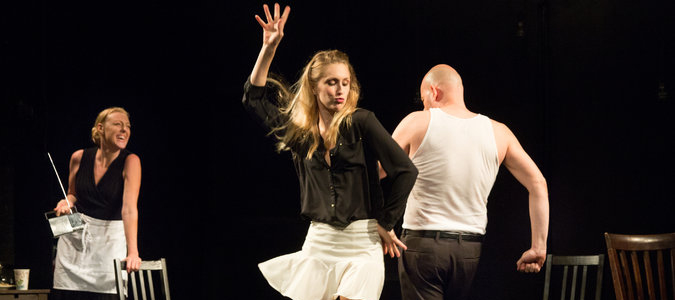
A staple of the theater is deconstructed, reconstructed, teased or rewritten through the sensibilities of four different writers in Bastards of Strindberg, a collection of short plays inspired by Miss Julie, being presented at the Lion Theater by the Scandinavian American Theater Company. August Strindberg’s heated drama about the combustion that occurs when a footman and a count’s daughter spend a tempestuous night together has remained surprisingly present on both stage and screen. A new film version with Jessica Chastain and Colin Farrell is due soon, and a South African production was acclaimed when it played at St. Ann’s Warehouse in 2012. Now the play has been put under a refracting lens by two Swedish writers, Lina Ekdahl and Andreas Boonstra, and two Americans, David Bar Katz and Dominique Morisseau. All four plays have their intriguing aspects, although, for me, the most engaging was Ms. Morisseau’s High Powered, directed by Henning Hegland, which moves furthest from the source material and doesn’t even include the character of Julie. Nevertheless, her presence hangs heavily in the air as Mya (Zenzele Cooper), Julie’s dog walker, and Mya’s boyfriend, Darrin (Kwasi Osei), the chauffeur to Julie and her rich father, pack up her belongings in boxes for Julie’s move across the country. The time is, obviously, today, and Ms. Morisseau’s work suggests that little has changed in the world, in terms of rigid divisions between class, since Strindberg wrote the play in 1888. “Thing is,” as Mya puts it, “most of the 1 don’t never see the potential in the 99. We be like there to do all the buildings, and they get to walk through a door or look out a window and never think about what’s holding those bricks together.”