














An Interracial Friendship in the 1950s, Poetically
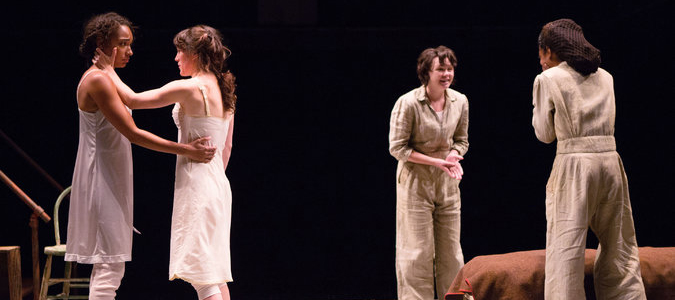
In And I And Silence, a challenging play by Naomi Wallace, two women, Dee and Jamie, one white, the other black, meet in prison when they are teenagers, and after they are released years later, struggle to survive together in a Southern town in 1959 – a struggle that ends in tragedy. That is a more or less accurate summary of the plot in this first of Naomi Wallace’s plays to be presented this season at the Signature. But it doesn’t really get at the play, which isn’t so straightforward. Wallace has two actresses portray each character. Scenes of the Young Dee (Emily Skeggs) and Young Jamie (Trae Harris) in prison alternate with scenes of the older Dee (Samantha Soule) and Jamie (Rachel Nicks) in the room that the two wind up sharing. Both scenes take place on the same spare set, on a kind of narrow catwalk that runs down the center of the Griffin Theater, splitting the audience in two. The abstract quality of the set reflects the language of the play. A respected theater artist who won a MacArthur “genius” fellowship, Wallace began as a poet, and her love of poetry strongly influences her approach to storytelling on the stage. The title of this play comes from a line from Emily Dickinson’s poem I felt a Funeral, in my Brain; some of the dialogue is in rhyming couplets. The playwright’s feel for language can be rewarding:
“Soup for weeks now,” Dee complains to Jamie. “I hate soup.”
“Well, I don’t think it likes you either, Dee, ’cause you always disrespect it. But after the rent it’s all we can afford.”
But Wallace’s lyrical approach (the less tolerant would call it arty or vague) sometimes seems to work against the play’s apparent purpose. Originally commissioned by the London company Clean Break to perform in women’s prisons, And I And Silence seems meant to depict a “turbulent era” in American history, and expose what Wallace calls “one of the most oppressive economic systems in the world.”