













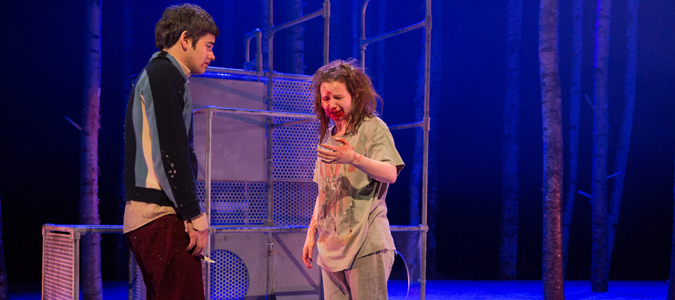

Trying to Smarten Up Vampire Romance, With Let the Right One In
The frequent collaborators John Tiffany and Steven Hoggett seem to be everywhere these days, not just geographically but narratively. Whether the tale they’re telling is psychological (as in the recent Broadway Glass Menagerie) or sociopolitical (Black Watch) or mytho-historical (the Alan Cumming Macbeth) or just groovy (What’s It All About?, the Burt Bacharach revue Hoggett put together) they almost always manage the difficult trick of cutting to the bone while raising the emotional temperature. To do this, they bring a certain amount of magic to their realism, as when Laura in that great Glass Menagerie made her first entrance and final exit through a kind of memory-wormhole in a sofa. But they also bring a certain amount of realism to their magic, and that’s an iffier proposition. At any rate, it’s a problem in their production of Let the Right One In, a vampire romance now at St. Ann’s Warehouse in Dumbo. The show — directed by Tiffany, with Hoggett as associate director and also in charge of movement — finds the pair at the top of their form visually and emotionally but intellectually overwrought, if not sucked dry. Let’s face it: Vampire stories are not the deep end of literature, no matter what metaphorical pretensions are offered in their defense. This one, adapted by Jack Thorne from a 2004 Swedish novel and 2008 film (later remade in English as Let Me In), offers too many. The most obvious are played out in the relationship between the play’s main characters: a lonely young teen named Oskar and Eli, a vampire girl — if she is a girl — who moves into the flat next door. Oskar is not only tortured by homophobic bullies at school but also woefully under-parented. (His alcoholic mother and possibly gay father are divorced and seem to be involved in a contest to see who can ignore him most.) Meanwhile, Eli, a permanent member of a despised minority whose “difference” is mixed up in some way with sexuality, is also under-parented: She has no mum or dad to stop her from walking around in the snow without shoes. True, the man who procures blood for her could be seen as a kind of father figure, but only if your idea of paternal love also includes erotic longing and threats of self-harm with sulfuric acid. In any event, because he is human and aging, he is starting to fail in his duties. Parents! And yet not just parents; the play suggests a chain of un-mindfulness leading from home to school to town to nation. (Despite retaining the Swedish names, Let the Right One In appears to take place in Scotland; it was commissioned by that country’s National Theatre.) This being the early 1980s, that all-purpose bogeyman Ronald Reagan even gets a shout-out; he is heard on the telly promoting his Star Wars initiative. We are meant to understand that Evil Empires are not the work of misunderstood vampires and belittled children but of authority figures too involved in their own petty schemes and megalomaniacal delusions to notice the damage being done all around them.